
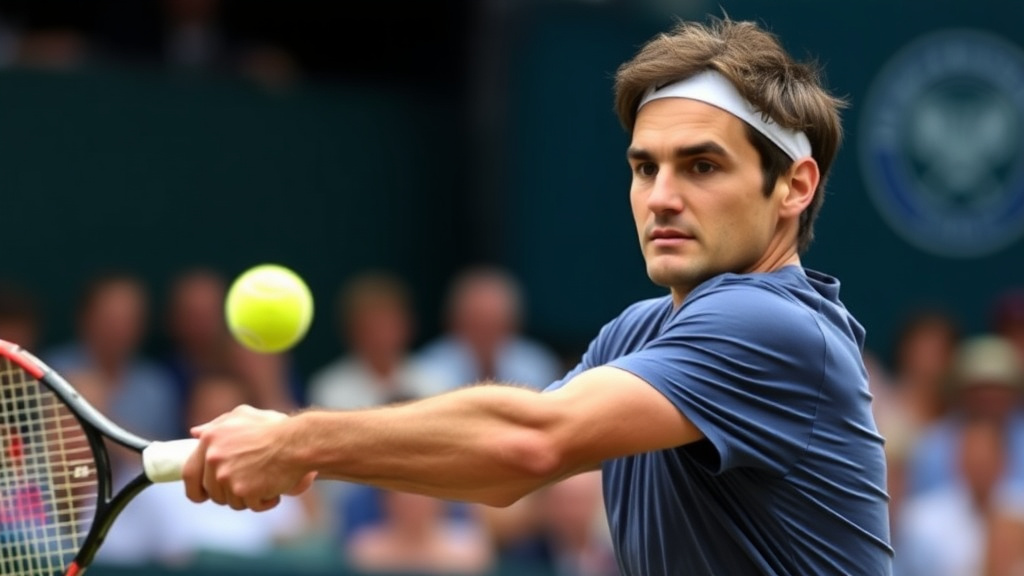
Roger Federer’s serve has historically been considered one of tennis’s most formidable weapons, but few grasp how substantially it transformed the sport’s strategic landscape. This article investigates the biomechanical innovations and competitive intelligence behind Federer’s groundbreaking serving technique, analyzing how his style questioned conventional wisdom and shaped an entire generation of professional players. From his unique grip and technique to his tactical positioning and range, we’ll discover why his serve became the foundation for modern tennis excellence and revolutionized how the game is performed today.
The Structure of Federer Serve Innovation
Mechanical Accuracy and Grip Mastery
Roger Federer’s serve advancement begins with his unique grip style, which diverges from conventional continental methods. His semi-western grip position on the racket handle delivers outstanding range and precision, allowing him to produce both strength and rotation in tandem. This technical benefit permitted Federer to deliver serves with remarkable precision and range. The grip significantly changed how players approached serve mechanics, encouraging coaches worldwide to reassess conventional training approaches and grip recommendations for up-and-coming athletes.
Movement Smoothness and Kinetic Chain Efficiency
The fluidity of Federer’s service technique represents another cornerstone of his revolutionary technique. His seamless kinetic chain—from feet to shoulders to arm to wrist—generates optimal power transmission throughout the serve. Unlike the jerky, segmented motions of many contemporaries, Federer’s smooth acceleration generates tremendous racket head speed with little exertion. This optimization reduces injury risk while boosting performance, showing that polished mechanics often exceeds raw power in professional tennis competition.
Effect on Professional Tennis Tactics
Federer’s groundbreaking serve dramatically changed competitive tennis strategy, forcing opponents to reassess their defensive approaches and baseline tactics. The accuracy and diversity he demonstrated created a new standard that elevated serve-focused competition across professional circuits. Coaches worldwide began focusing on serve improvement in training programs, recognizing that modern tennis success was built upon offensive serving capabilities. This shift sparked widespread strategic reviews throughout the sport, influencing how players structured points and navigated match dynamics.
Defensive Strategies by Competitors
Competing professionals addressed Federer’s dominance by creating sophisticated return strategies specifically designed to neutralize his serve strengths. Players invested significant training time improving return positioning, reading serve tendencies, and improving reaction speeds. The attacking return became more widespread as competitors aimed to disrupt Federer’s rhythm and reduce his service-game effectiveness. These tactical adaptations represented a direct evolution necessitated by the requirement to neutralize his remarkable serving skill and maintain competitive viability.
Modern returners adopted increasingly attacking stances, standing nearer the baseline and employing quicker racquet setup methods. Psychological pressure intensified as players worked to disrupt service games more consistently, converting the return game into an offensive weapon rather than merely defensive necessity. Federer’s influence inadvertently elevated the overall quality of return play across the professional game, as competitors continuously enhanced techniques to counter his serve’s exceptional characteristics and preserve parity among players.
Evolution of Service Return Strategies
The return of serve evolved dramatically as professionals studied and neutralized Federer’s serve techniques, developing increasingly advanced strategic methods. Players began studying serve patterns meticulously, detecting placement tendencies and capitalizing on predictable routines. Advanced analytics and motion capture systems enabled comprehensive serve examination, allowing competitors to construct personalized return strategies. This data-driven methodology revolutionized return training from intuitive practice into analytics-based systems, fundamentally changing how professionals tackled one of tennis’s most critical skills.
Modern returners now employ multiple positioning approaches, including positioning deeper inside the baseline or beyond the court lines based on serve tendencies. Attacking return strategies, featuring early racket preparation and advancing toward the net, evolved into standard professional practice. The psychological element intensified as returners pursued first-strike advantages, shifting match dynamics from serve-dominant patterns toward increasingly competitive exchanges. Federer’s outstanding serve unintentionally hastened return-of-serve evolution, setting new performance benchmarks that keep shaping professional tennis strategy today.
Legacy and Future of the Tennis Serve
Federer’s Lasting Impact on Professional Tennis
Roger Federer’s groundbreaking serve technique has substantially changed how modern professional players approach the game. His impact transcends individual matches; it has revolutionized coaching approaches, movement science, and strategic approaches across every tier of competitive tennis. Aspiring professionals now analyze Federer’s serve mechanics as a benchmark in efficiency and effectiveness, applying his principles into their own development. Tennis coaches globally have embraced his advanced methodology to hand placement, positioning mechanics, and motion sequencing. The lasting influence of his innovations continues to elevate the performance benchmarks required for aspiring professionals, establishing new standards for outstanding achievement that define contemporary tennis strategy and training systems globally.
Development and Advancement in Future Service Methods
The future of tennis serving will undoubtedly build upon the fundamentals Federer laid down, as players and coaches remain focused on perfecting and advancing his techniques. Emerging technologies, encompassing advanced biomechanical analysis and artificial intelligence, allow deeper understanding of serve mechanics and optimization strategies. Next-generation players are already exploring variations of Federer’s approach, integrating his classical elegance with modern athletic science. As tennis progresses, his legacy serves as both inspiration and foundation, encouraging continuous improvement while respecting the fundamental principles that made his serve revolutionary. The sport’s trajectory suggests that Federer’s influence will continue to be essential to tennis excellence for decades to come.
